Murder of Charles Whitehorn
Killers of the Flower MoonThe Murder of Charles Whitehorn was an unsolved 1921 killing that exposed the limits of the official explanation for the Osage Reign of Terror. Although investigators found no evidence tying William K. Hale or his associates to the crime, private detectives and federal agents developed a separate theory: that Charles Whitehorn’s widow, Hattie Whitehorn, and other conspirators arranged his death to seize his headright and fortune. The case never produced a prosecution, but its unresolved trail challenged the idea that one mastermind accounted for the era’s killings.
The killing and its first clues
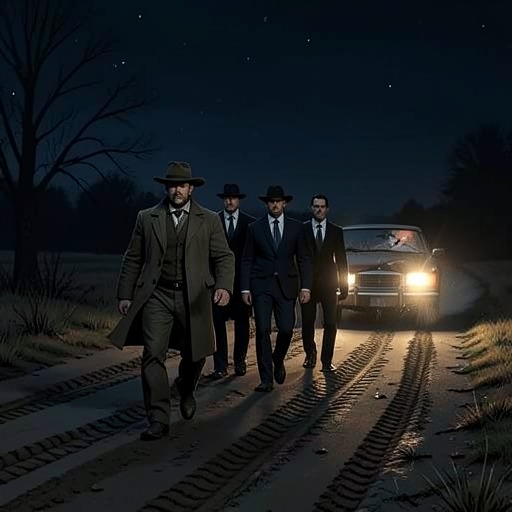
Charles Whitehorn was last seen alive in Pawhuska, capital of the Osage Nation, on May 14, 1921. At about eight that evening, a witness spotted him outside the Constantine Theater. His body was discovered two weeks later on a hill roughly a mile from downtown. An undertaker observed that its position suggested Whitehorn had fallen where he was found rather than being carried there.
The weapon was a .32 revolver, and Whitehorn had been shot twice between the eyes. Those details suggested a deliberate killing, perhaps a professional hit, but did not identify a perpetrator. The timing added to the case’s significance: the murder occurred in May 1921, around the same period as Anna Brown’s killing, at what was considered the beginning of the four-year Reign of Terror. Yet no evidence surfaced implicating Hale or his henchmen.
Whitehorn’s estate hired private detectives, whose logs later supplied a substantial body of clues. Vaughan, an attorney familiar with the Osage, offered help because he wanted the guilty party prosecuted. He and the investigators did not know that Vaughan himself would be murdered within two years. Comstock, an attorney and guardian whom investigators had initially suspected but who had proved trustworthy, also assisted. He relayed a report that an unidentified man had been seen lurking on the hill on May 14, the day Whitehorn disappeared.
A separate conspiracy takes shape
Working from informants and circumstantial evidence, the private detectives came to suspect that Whitehorn’s killing was intended to transfer his wealth. After his death, Hattie married LeRoy Smitherman, an unscrupulous white man. Investigators believed Minnie Savage, who ran a boardinghouse in Pawhuska, had orchestrated the marriage. They suspected Savage, Smitherman, and other conspirators of arranging the murder to obtain Whitehorn’s headright and fortune. As the inquiry continued, some investigators also came to believe Hattie had been involved; an informant characterized her as a leading participant. Her rapid spending of some of her husband’s money after his death fed suspicion, but neither suspicion nor circumstantial evidence established guilt.
The detectives placed an undercover operative in Savage’s boardinghouse to listen to telephone conversations. Savage’s sister became another source of information, telling investigators that she had seen what was likely the murder weapon: a large, dark-colored gun that Savage picked up from beneath a pillow while making a bed. These leads sharpened the theory of the crime but did not yield enough evidence to prosecute anyone. The reports leave open the possibility that the private detectives failed to build a prosecutable case or were bought off; they do not resolve which explanation is true.
Federal inquiry and a failed confession
When Bureau of Investigation agents examined the case in 1923, they likewise suspected Savage, Smitherman, and Hattie. Their working theory was that Hattie had caused her husband’s murder to gain control of his estate. She denied involvement and warned an agent that she had been cautioned about the investigators. She also refused to tell them what she knew, saying in effect that disclosure could send her to the electric chair.
The investigation acquired new complications when Smitherman fled to Mexico with Hattie’s car and some of her money. J. J. Faulkner then entered Hattie’s life and, agents believed, used knowledge she had shared about the murder to blackmail and control her. Hattie’s sister confronted him over his demands; Faulkner responded that he knew about Hattie and the killing and that the family should be careful. Agents suspected he was trying to secure control of Hattie’s property after her death as well as money while she lived.
Hattie became gravely ill, and Faulkner’s wife said he was preventing her from going to a hospital to keep her under his influence. Hattie’s sisters reported that he was taking money from her while she was under the influence of a narcotic. The sisters eventually got her admitted to a hospital. Agents, expecting her to die, tried to obtain a confession. They reported that Hattie had told Comstock she knew the facts but had never disclosed them, and that the conspirators had sent her away when Whitehorn was murdered. She revealed nothing further. After she was removed from Faulkner’s control, she recovered. Though poisoning had figured in other suspected crimes of the Reign of Terror, the agents did not express suspicion about the nature of Hattie’s illness.
An unresolved case and a larger history
By the time Tom White arrived to investigate in 1925, the Bureau had largely set the Whitehorn case aside. Agent Burger described it as an isolated murder, disconnected from the systematic killings. The case did not fit the Bureau’s preferred account: that a single mastermind was responsible and that capturing Hale and his associates would solve the Osage murders. Whitehorn’s killing remained officially unresolved, with no conviction establishing who arranged it or carried it out.
That very separation gives the case its wider significance. The evidence did not prove that Hale played no role, but investigators never found a connection between him and this plot. In retrospect, the suspected conspiracy against Whitehorn—and the later suspected effort to control his widow—suggested that predatory violence was not confined to Hale’s circle. Like the suspicious death of Red Corn’s grandfather, the case points toward a history of possible brutality that incomplete investigations and the deaths of the principal figures left difficult to recover. Its unanswered questions complicate any neat ending in which the capture of one group could be taken to mean that the broader system of violence had been explained.